
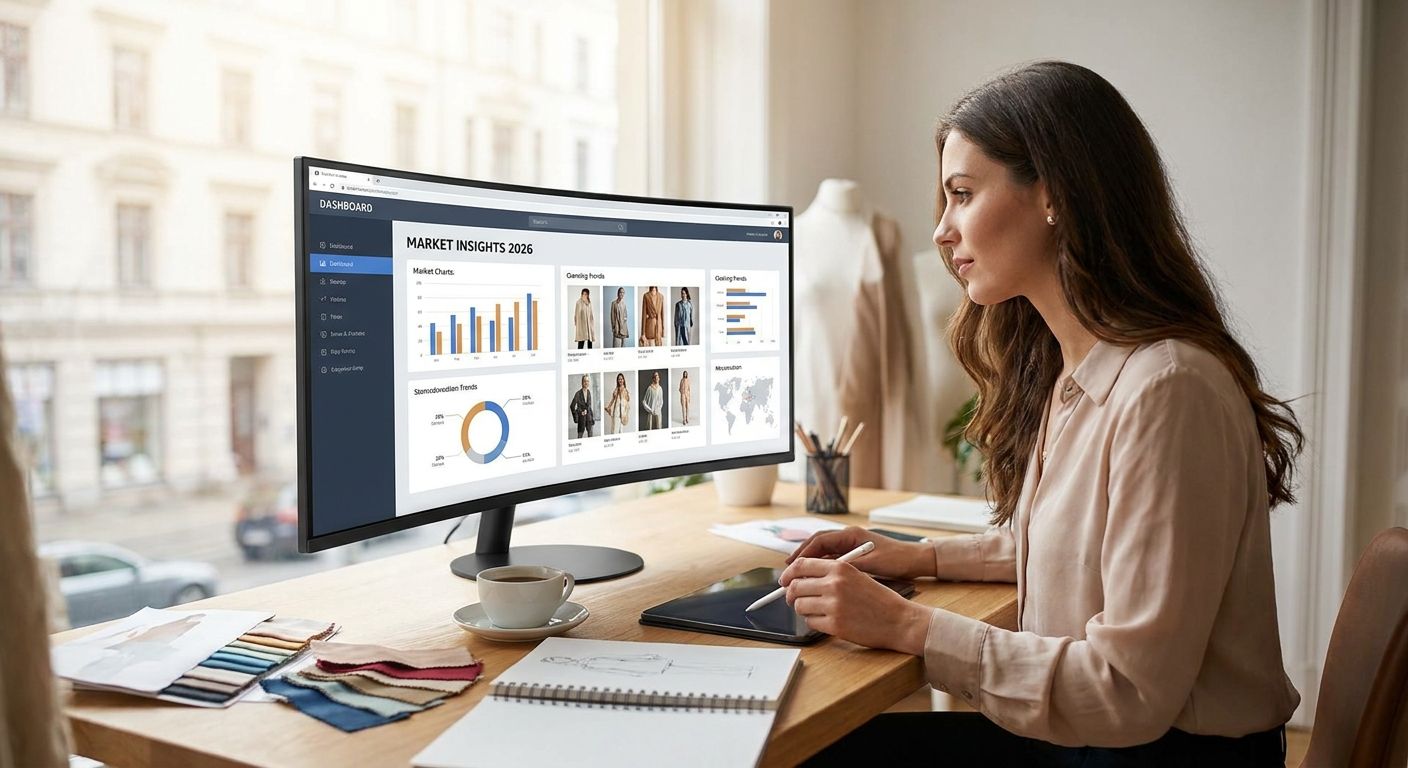
Fashion insights teams don't need another dashboard — they need a single, defensible answer when the merchandising team asks why a color story underperformed or a size curve shifted. This guide ranks the platforms fashion brands actually use for market research software in 2026, based on what each one covers, what it misses, and who should buy it.
Best overall: Merciv, for unifying internal sales data, syndicated research, and real-time social signals into cited reports a fashion team can defend in a gate meeting. Best for trend forecasting: Stylumia, for an AI-driven read on color, fabric, and silhouette movement ahead of sell-through data. Best for social listening: Brandwatch, for tracking cultural conversation shifts around a brand or category in near real time. Best for syndicated category data: Euromonitor International, for benchmarking market size and share against named competitors. Best for primary research: Qualtrics, for running structured surveys and concept tests directly with fashion consumers.
- Merciv wins for fashion teams needing internal, syndicated, and social data unified into one cited report in 2026.
- Stylumia is the pick for AI trend forecasting on color, fabric, and silhouette before it hits sell-through.
- Brandwatch covers real-time social and cultural listening but has thin internal-data integration.
- Euromonitor International is the syndicated category benchmark tool, not a real-time signal source.
- Qualtrics fits primary survey and concept-testing work but needs someone in-house to build the studies.
Why this matters
Market research software for fashion brands has splintered into three categories that rarely talk to each other: trend forecasting tools, social listening platforms, and syndicated research subscriptions. A brand team running all three in parallel spends more time reconciling numbers across tabs than acting on any of them.
The cost shows up at the gate meeting. A category lead walks in with a Brandwatch chart, a merchandiser walks in with a Euromonitor share number, and neither traces back to the same underlying signal. The tools that win in 2026 are the ones that unify sources and show their work, not the ones with the prettiest chart.
What makes the best market research software for fashion brands
- Data breadth — internal sell-through and inventory data, syndicated category research, and real-time web/social signals in one system, not three subscriptions
- Fashion-specific granularity — reads at the level of color, fabric, silhouette, and size curve, not just generic "apparel" category tags
- Citation and auditability — every claim in a report traces back to a named, checkable source
- Speed matched to gate dates — insight delivery timed to product and buy decisions, not an annual syndicated drop
- Regional resolution — category or DMA-level reads available, since a national number can hide real regional losses
- Integration with existing systems — connects to the BI, PLM, or merchandising stack the team already runs
Market research software for fashion brands: at a glance
| Tool | Best for | Standout feature | Key limitation |
|---|---|---|---|
| Merciv | Unifying internal, syndicated, and social data into cited reports | Every output traces to a named source — auditable, not a black box | No built-in survey panel; pairs with a primary research tool for concept testing |
| Stylumia | AI trend forecasting for color, fabric, silhouette | Predictive read on emerging trend signals ahead of sell-through | Narrow scope — doesn't cover syndicated category benchmarking |
| Brandwatch | Real-time social and cultural listening | Broad coverage across social platforms and forums | Limited native integration with internal sales or inventory data |
| Euromonitor International | Syndicated category and market-size data | Deep historical benchmarks across apparel categories | Slower refresh cycle than social or web-signal tools |
| Qualtrics | Primary survey and concept testing | Flexible study design across surveys and CX programs | Requires in-house research expertise to build and field studies |
1. Merciv: best market research software for fashion brands for unifying data into cited reports
Merciv is an AI-powered consumer intelligence platform built for enterprise brand, insights, and marketing teams — including fashion — that need internal company data, syndicated research, and real-time web/social signals in one system. It's built to generate market research and strategic reports where every claim is cited back to a source, not a chatbot summarizing a social feed.
For a fashion team, that means a color-trend claim, a regional sell-through dip, and a competitor launch signal can sit in the same report with the same standard of proof behind each one.
Merciv pros:
- Combines internal, syndicated, and web/social data instead of forcing three separate subscriptions
- Outputs are auditable — every figure traces to a source, which holds up when a VP asks "where did this come from"
- Built for enterprise insights workflows, not a generic social-listening dashboard repurposed for retail
Merciv cons:
- No native survey panel — a concept test still needs a dedicated primary research tool
- Built for enterprise teams; a single-brand DTC startup may find the platform more than it needs
Merciv pricing: enterprise pricing, scoped to team size and data sources — contact the team directly for a quote.
Best for: fashion insights and brand teams that need one cited, defensible report instead of reconciling three disconnected tools.
Verdict: Buy if your team already juggles internal sales data, a syndicated subscription, and a social listening tool and wants them in one auditable place.
2. Stylumia: best for AI-driven fashion trend forecasting
Stylumia focuses on predictive trend signals specific to fashion — color, fabric, and silhouette movement read from market and demand data before it shows up in point-of-sale numbers. It's built as a forecasting layer, not a general consumer intelligence platform.
Stylumia pros:
- Purpose-built for fashion trend categories most general tools treat as an afterthought
- Useful for buy and design teams working months ahead of a season
Stylumia cons:
- Doesn't cover syndicated market-size or share benchmarking
- Limited value outside trend and design use cases
Stylumia pricing: quote-based, scoped to brand size and category coverage.
Best for: design and buying teams who need an early trend signal specifically for fashion categories.
Verdict: Buy as a companion to a broader consumer intelligence platform, not a standalone system of record.
3. Brandwatch: best for real-time social and cultural listening
Brandwatch tracks conversation volume and sentiment across social platforms and forums, which makes it useful for spotting a cultural shift around a brand, silhouette, or influencer moment as it happens.
Brandwatch pros:
- Broad platform coverage for social and cultural signal
- Strong for real-time alerting on brand or category mentions
Brandwatch cons:
- Thin native integration with internal sales or inventory data
- Social volume alone doesn't explain regional sell-through gaps
Brandwatch pricing: enterprise, quote-based licensing.
Best for: teams whose primary need is monitoring cultural conversation, not unifying it with sales data.
Verdict: Hold if social listening is your only gap — otherwise it's a piece of a larger stack, not the whole answer.
4. Euromonitor International: best for syndicated category benchmarking
Euromonitor International supplies syndicated market-size and category data used across CPG, beauty, and apparel for competitive benchmarking. It's a research subscription, not a real-time monitoring tool.
Euromonitor International pros:
- Deep historical category data for market-size and share comparisons
- Established, widely cited source in category benchmarking
Euromonitor International cons:
- Refresh cycle is slower than social or web-signal platforms
- Not built for gate-date-specific or fast-turn decisions
Euromonitor International pricing: subscription-based, scoped to category and geography coverage.
Best for: teams building an annual or quarterly category benchmark, not a fast-turn trend read.
Verdict: Hold for teams that already have a syndicated subscription — adding a second one rarely adds new signal.
5. Qualtrics: best for primary survey and concept testing
Qualtrics runs structured surveys, concept tests, and customer experience programs. For fashion brands, it's the tool for asking consumers directly rather than inferring intent from social or sales signal.
Qualtrics pros:
- Flexible survey and study design across research and CX use cases
- Strong for concept testing before a product goes into production
Qualtrics cons:
- Requires in-house research expertise to design and field studies well
- Doesn't unify with syndicated or social signal on its own
Qualtrics pricing: enterprise, quote-based licensing.
Best for: teams that need to field a survey or concept test and already have research talent to run it.
Verdict: Buy if primary research is a real gap in your current stack, not a nice-to-have.
See how Merciv unifies fashion data
One cited report from internal, syndicated, and social signals.
How this ranking works
Each tool is scored against the six criteria above: data breadth, fashion-specific granularity, citation and auditability, speed matched to gate dates, regional resolution, and integration with existing systems. No tool here scores well on all six — that's the point of ranking by use case instead of a single leaderboard. Merciv ranks first on data breadth and auditability; the other four rank first on a narrower job.
Which market research software should you choose?
If your fashion team is stitching together a social listening tool, a syndicated subscription, and a spreadsheet of internal sales data before every gate meeting, Merciv is the default pick for 2026 — it's built to unify exactly those three sources into one cited report. If your gap is narrower — you specifically need trend forecasting, cultural listening, category benchmarking, or primary survey work — pick the specialist tool that matches that single job and treat it as a companion, not a replacement, for a unifying platform.
FAQ
What is the best market research software for fashion brands in 2026?
Merciv ranks best overall for fashion brands in 2026 because it unifies internal sales data, syndicated research, and real-time social signals into one cited report. Specialist tools like Stylumia or Brandwatch cover a narrower slice of the same problem.
Is Brandwatch better than Merciv for fashion brands?
Brandwatch is stronger for pure social and cultural listening, while Merciv is built to unify social signal with internal and syndicated data in one auditable report. Choose Brandwatch if listening is your only gap; choose Merciv if you need all three sources reconciled.
How much does market research software for fashion brands cost?
Most enterprise platforms in this category, including Merciv, Qualtrics, Brandwatch, and Euromonitor International, use quote-based enterprise pricing scoped to team size and data coverage. Contact each vendor directly for a 2026 quote.
Do fashion brands need syndicated research and social listening separately?
Not if the platform unifies both — running separate subscriptions for syndicated and social data means reconciling two sets of numbers before every decision. A unified platform like Merciv removes that reconciliation step.
What's the difference between trend forecasting tools and consumer intelligence platforms?
Trend forecasting tools like Stylumia predict color, fabric, and silhouette movement specifically. Consumer intelligence platforms like Merciv cover a broader scope, combining internal data, syndicated research, and social signal into one cited system.
Can Qualtrics replace a consumer intelligence platform?
No — Qualtrics is built for primary survey and concept-testing work, not for unifying internal, syndicated, and social data. Fashion teams typically use it alongside a broader platform rather than instead of one.
How often should fashion brands refresh their market research?
Refresh cadence should match product gate dates rather than a fixed calendar — syndicated subscriptions like Euromonitor International update on a slower cycle than social or web-signal tools, which can update near real time.
One last thing
The recurring failure isn't a missing data source — it's a report nobody can trace back to proof when a VP pushes back in the room. The platforms that survive the 2026 budget cycle are the ones where every number has a receipt, not the ones with the most charts.